
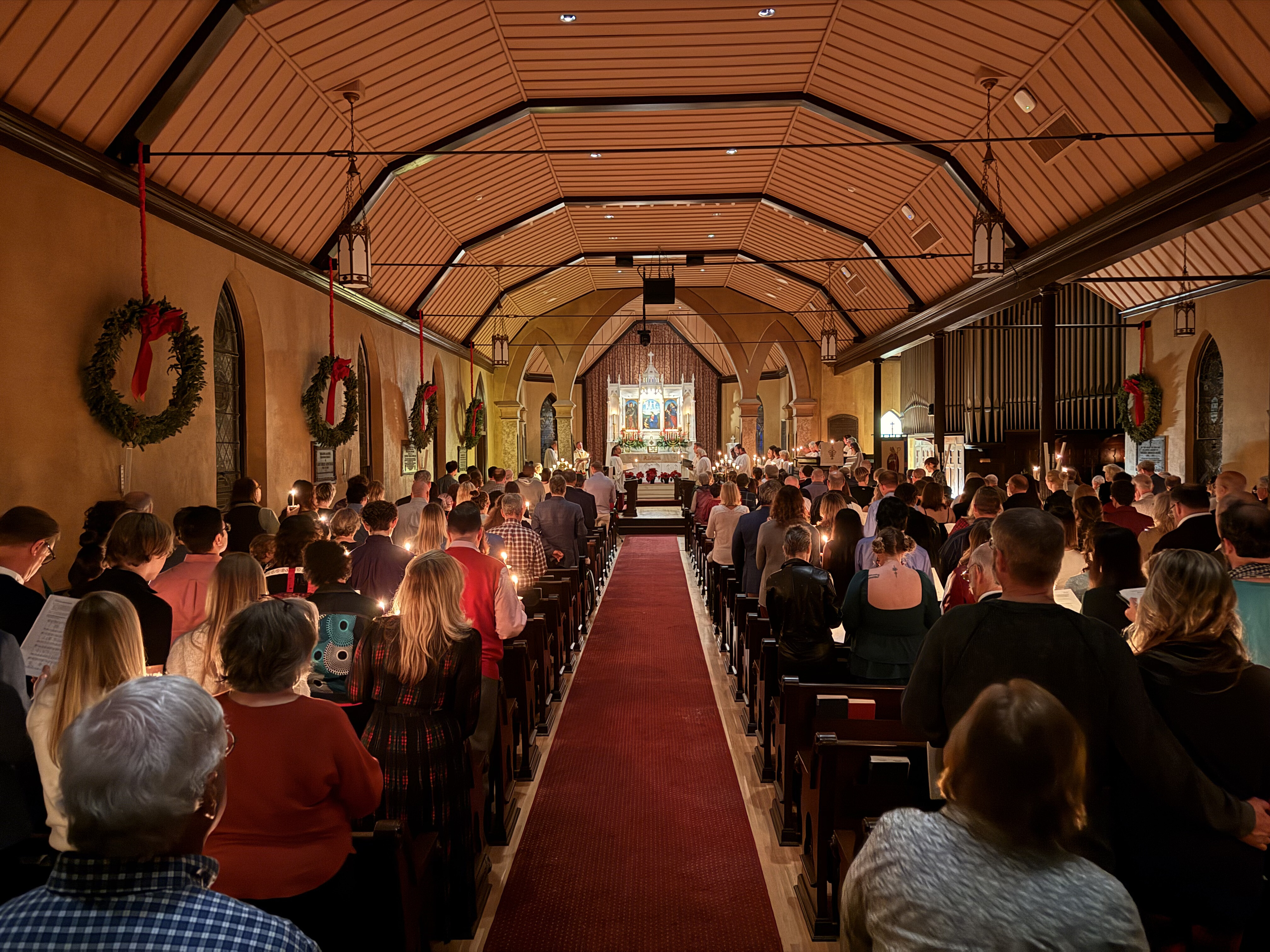
Christmas Eve
This Christmas Eve we continue our recent tradition of an extended choral prelude to the anticipated celebrations of the Midnight Mass of Christmas (which in current custom generally displace the celebration proper to Christmas Eve).
The prelude begins with the ‘Christmas Proclamation’, a chant which places the birth of Our Lord in the context of worldly history: the divine becoming human in a very specific place and time, which allowed him to have universal reach.
This is followed with a song, ‘Personent hodie’ [Hymn 92], from a now well-known collection of late-medieval religious song compiled by a schoolmaster in Swedish-controlled Finland in the sixteenth century, Piae Cantiones. ‘Personent hodie’ (in the original Latin, which my translation follows more closely than the Hymnal’s) calls upon schoolboys, along with the clerics in their scholastic–ecclesiastical community, to sing praise to Christ, also telling the story of the nativity and visit of the Magi. One can imagine it being used in a procession or pageant, much as we will present it.
Two carol settings by David Willcocks, a prominent twentieth-century English choral musician who – often for the famous Christmas Lessons & Carols at King’s College, Cambridge – breathed new life into a sometimes slightly stodgy eighteenth- and nineteenth-century repertory of English Christmas hymns. The easygoing ‘Sussex Carol’ is given a sparkling organ accompaniment and a three-part treble descant; for ‘God rest you merry, gentlemen’, Willcocks provided his trademark rich reharmonizations and another three-part descant. (His arrangements of ‘Hark! the herald angels sing’ – music by Felix Mendelssohn written to celebrate the 400th anniversary of Gutenberg’s invention of printing from movable type! – and ‘Once in royal David’s city’ are sung during the liturgy itself.)
A Mexican carol addressed to the shepherds, ‘Volemos, pastorcitos’, is given a hauntingly beautiful setting by Russell Schulz-Widmar, longtime professor of music at Austin’s Seminary of the Southwest and an important shaper of the Hymnal 1982 as well as a prolific composer and arranger. The prelude concludes with a stirring setting of the French carol ‘O leave your sheep’ (‘Quittez, pasteurs’) by modern English composer Kenneth Leighton, the equal of the fine English text that promises us a Savior ‘...in love arrayed: a love so deep, ’tis able to search the night for you’.
The carol ‘In dulci jubilo’ must have been sung across much of Northern and Central Europe in the late Middle Ages, given the wide spread of the sources in which it is found. Prolific seventeenth-century German composer Michael Praetorius wrote several settings, of which we sing one (at the Offertory) written for ‘double choir’ (‘choir’ in that period often meaning a group of singers and instruments, with some parts played rather than sung). The tune is familiar to us from its use with the nineteenth-century English text ‘Good Christian friends, rejoice’ [Hymn 107].
Finally, our Communion anthem is an early-twentieth-century setting of a medieval English carol. Gustav Holst set the narrative verses of ‘Lullay my lykying’ for soloists in a folk-like, quasi-improvisatory style, punctuating them with a choral refrain that constitutes a lullaby (perhaps sung by the Blessed Virgin to her newborn Son).
Christmas Day and Sunday Following
On Christmas morning and the Sunday following, the focus turns from the infant Jesus to the eternal Word. The Prologue to the Gospel of John tells us that ‘In the beginning was the Word, and the Word was with God, and the Word was God...’ This Word (Greek Logos, which refers more to speech and the thought behind it than to an individual word) is the manifestation of God’s mind and will, making known God’s glory and grace – in all of creation, but also, even more wondrously, in human flesh, in the person of Jesus of Nazareth. This tells us something about God – that the Divine, out of love, would deign to become so limited – but also tells us something about creation and about humanity in particular: that it was and is somehow, by God’s grace, found fit to house the Holy. This mystery and hope is what we celebrate at Christmas, aided by some of our hymnody.
‘O come, all ye faithful’ [‘Adeste fideles’, 83], though set at the stable in Bethlehem, draws upon John 1 as well as the Nicene Creed and the Te Deum laudamus (a very early Christian hymn) to explain what we are invited to behold:
God from God, Light from Light eternal... only-begotten Son of God the Father... Jesus, to thee be glory given; Word of the Father, now in flesh appearing...
This eighteenth-century Latin hymn is usually ascribed to the Englishman John Francis Wade; the familiar music may also be his. Interestingly, the oldest manuscript, from around 1745, notates the tune in triple meter, giving it the air of a stately dance.
Our Sequence hymn, ‘Of the Father’s love begotten’ [‘Corde natus ex parentis’, 82], was written by the fourth-century Spanish lawyer, government official, and religious poet Marcus Aurelius Prudentius. A more literal translation of the first line would read ‘Born from the heart of the Parent’, which brings us once again to John 1 (‘It is God the only Son, who is close to the Father’s heart, who has made him known’). The text goes on to speak further of the role of the eternal Word:
Of the Father’s love begotten,
ere the worlds began to be,
he is Alpha and Omega,
he the source, the ending he,
of the things that are, that have been,
and that future years shall see,
evermore and evermore!
The gracious chant melody to which this hymn is now sung dates from the thirteenth century and was originally associated with a trope (poetic expansion) of the Sanctus which begins ‘Divinum mysterium’, which has given the music its modern title. St David’s now also uses this music to sing the Marian hymn ‘Ye who claim the faith of Jesus’. [268/269].
William Chatterton Dix’s ‘What child is this, who, laid to rest’ [115] also draws upon John 1: ‘Good Christian, fear: for sinners here / the silent Word is pleading’; in the original, this stanza, rather than repeating the text which now serves as a refrain to all three stanzas in the Hymnal, continues with a reference to the Crucifixion and ends ‘Hail, hail the Word made Flesh, the Babe, the Son of Mary!’ Christina Rossetti’s ‘In the bleak mid-winter’ [112] also approaches this mystery with appropriate awe:
Our God, heaven cannot hold him,
nor earth sustain;
heaven and earth shall flee away
when he comes to reign:
in the bleak midwinter
a stable-place sufficed
the Lord God incarnate,
Jesus Christ.
Much of the rest of both of these hymns invite us to reflect and respond to the Incarnation on a personal level: ‘So bring him incense, gold, and myrrh... let loving hearts enthrone him’; ‘What can I give him, poor as I am? ... What I can I give him: give my heart’. Perhaps the Church’s short season of Christmastide, after much of the worldly bustle has subsided, can provide us the necessary room to do so.
Second Sunday After Christmas
On the Second Sunday after Christmas (which does not occur every year), the lectionary offers three Gospel options concerning the early life of Our Lord. This year we read the account of the Wise Men from the East in a preview of the Feast of the Epiphany.
‘Angels, from the realms of glory’ [93] helpfully leads us from the Nativity to the Epiphany to the Presentation of Our Lord in the Temple addressing in turn the angels, the shepherds, the ‘sages’ (Wise Men), and the ‘saints before the altar bending’ (Simeon and Anna). A former or current vocation of each is named and confirmed, and then each is promised or invited to a new action or state of affairs in light of the coming of Christ: something we might well experience ourselves. This fine hymn was written by James Montgomery (1771–1854), a Scottish-born poet, newspaper editor, and social activist, a number of whose hymns are found in our hymnal, and is set to a tune by the Victorian English organist and composer Henry Smart.
‘As with gladness men of old’ [119] focuses on the desired parallels between the adoration and gifts offered by the Magi and our own worship: each of the first three stanzas is set constructed ‘As they ..., so may we...’. In the last two stanzas this pattern gives way as the author returns to the image of the star that began the hymn, with a prayer that we may follow Jesus (the true Light) in our earthly lives, and be brought at last ‘where they need no star to guide’: an idea expanded upon in the final stanza, which borrows from Revelation 21 and 22. The graceful tune, of German origin, was first adapted for English-language use with this text and so was named for the hymnist, William Chatterton Dix, author also of ‘What child is this’ (which, though not an Epiphany hymn, actually mentions ‘incense, gold, and myrrh’ whereas the present one does not).
‘What star is this, with beams so bright’ [124] is a translation of an eighteenth-century Latin hymn from France. It connects the star which the Magi are said to have followed with the ‘star out of Jacob’ in Numbers 24, and the Magi’s journey to seek Jesus with our own discipleship. It is set to a late medieval tune, ‘Puer nobis’, which is found in our Hymnal both in this triple-meter version (from a large collection of hymn settings by Michael Praetorius) and in a duple-meter version [98].

Login To Leave Comment