
Music Notes: Lent 2026
This week the Church has begun the great Lenten season of self-examination and repentance as we join with those (whether in our parish or not) who are undergoing instruction and preparation for their baptism at the Easter Vigil. The Lessons appointed in Lent across the three years of the lectionary cycle are all connected to this preparation, the baptismal rite itself, and the new life conferred in that Sacrament, in a tightly woven web of symbolism and allusion; a particularly important series of passages from John’s Gospel provides the key notes for Sundays in Lent in this first year of the lectionary cycle. Interspersed with hymns and anthems relating specifically to these appointed Scriptures are hymns for the season, both very old ones originally sung at Morning and Evening Prayer [152, 147, 143] and some new ones as well [149, 144]. Instead of an entrance hymn, on the other hand, we allow the organ prelude (at 9:00) and the series of chants intended for this purpose, the Introits that are over a thousand years old (at 11:15), to accompany the entrance of the ministers – that is, after the first Sunday in the season, when the Great Litany, an ancient form of prayer, is used for this purpose.
Lent 1
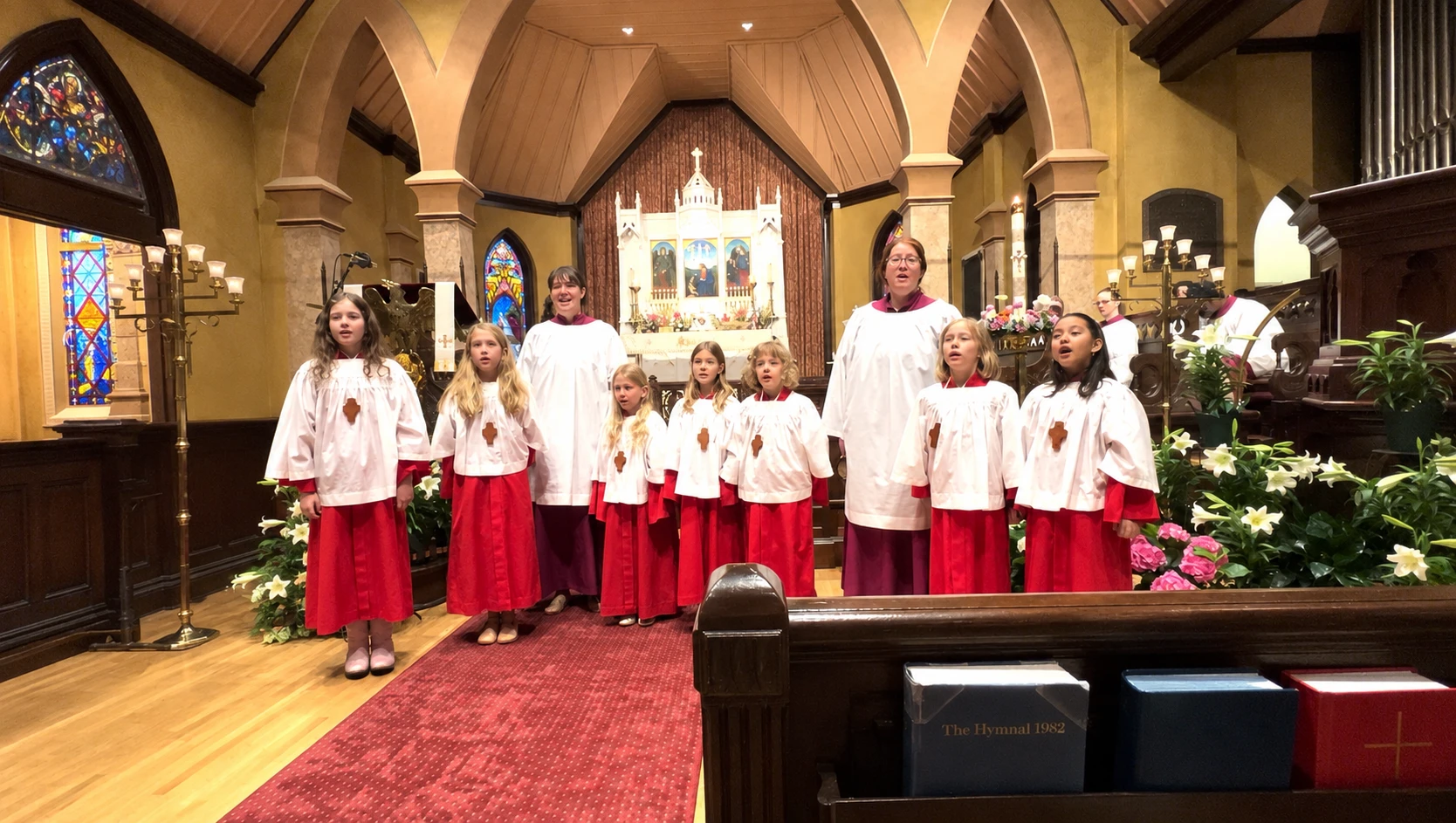
The First Sunday in Lent always has as its Gospel an account of the Temptation of Christ. This year this passage is paired with the account of the Fall of humanity, contrasting Our Lord’s steadfastness in the face of temptation with human weakness. Both ‘Forty days and forty nights’ [150] and ‘Lord, who throughout these forty days’ [142] recount the Temptation and ask that we, also resisting temptation and keeping the Lenten disciplines, saved by Christ and strengthened by his presence, may enjoy ‘the eternal Easter’. The children’s choir presents a setting of verses from Psalm 51 by living composer Gwendolyn Emery-Owings, while the Choral Scholars sing a meditative modern setting of John Donne’s ‘Hymn to God the Father’ [found with two much older, very beautiful, musical settings at Hymn 140/141]. The music of both ‘Forty days and forty nights’ (also the basis of the prelude, a set of variations by living composer Christa Rakich) and our Communion hymn, ‘Bread of heaven, on thee we feed’ [323], come from the same 1676 German collection of religious song intended for domestic use; a number of other tunes in our Hymnal come from collections of the same time, place, and purpose.
Lent 2
The visit of Nicodemus to Jesus by night appears in this Lenten series because of its theme of new birth and its baptismal reference, but the passage also includes the best-known Bible verse of all, John 3.16. The choir sings this verse in a striking mid-20th-century setting by Dutch-German composer Jan Bender that seems to focus on the sacrificial aspect of the passage. A very early Christian text, the Epistle to Diognetus, expounds on this verse and is the source for a fine modern hymn-paraphrase, ‘The great Creator of the worlds’ [489], whose ‘friendlier’ tone, focusing more on verse 17, is reinforced by its setting to a simple tune by the great English Renaissance composer Thomas Tallis. We commemorate the feast of our patron saint, David of Wales, which falls on this date, with Hymn 614, ‘Christ is the King! O friends, upraise’, which we have set to the familiar tune ‘O filii et filiae’ [203 / 206]. This tune, usually sung in Eastertide, expects Alleluias; for Lenten use we have replaced these with ‘Lord, have mercy’. I have arranged a fugue upon this tune, written for three instruments by living composer Nicola Canzano, for organ to serve as the prelude.
Lent 3
Water is the main theme this day: Jesus encounters the Samaritan woman at the well and speaks of ‘living water’; in the Exodus narrative, the Israelites receive water from a rock in the desert. ‘Shepherd of souls, refresh and bless’ [343] refers to the latter episode, while ‘O Food to pilgrims given’ [309] connects the Communion wine with the water (and of course the blood, which it is) that flowed from Our Lord’s pierced side at his crucifixion, which is also connected in Scripture and tradition with the water from the rock (I Corinthians 10.4). Our two anthems, both taken from the Hymnal, refer to the Gospel account. The second stanza of ‘I heard the voice of Jesus say’ [692] casts the singer as the woman at the well; the beautiful text, each stanza of which quotes a dominical saying and then responds to it from the perspective of the pilgrim Christian, is further elevated by the plaintive and rhythmically sophisticated music, another of Tallis’s tunes written for a metrical Psalter. A modern yet timeless folk-like song, ‘The first one ever’, highlights the crucial witness of several women in the Gospels, including the Samaritan woman; I have arranged Linda Willberger Egan’s work for our choir so that we may enjoy her excellent piece of songwriting craft. Another work by Christa Rakich, a strong organ prelude in the style of Bach, sets the early Reformation tune ‘Erhalt uns, Herr, bei deinem Wort’, to which, in a version by Bach, we sing the Office hymn ‘The glory of these forty days’ [143].
Lent 4–5
The related stories of the healing of the man born blind and the raising of Lazarus are read on the remaining two Sundays in Lent. On Lent 4 we sing a great Psalm of healing, release, and praise (146) in a metrical paraphrase, ‘I’ll praise my Maker while I’ve breath’ [429], both congregationally and in a choral setting by Claude Goudimel, who wrote multiple settings of all the hundred-odd tunes of the Genevan (Calvinist) Psalter including the one used here. This tune is also heard in settings for organ by the great Dutch composer Jan Pieterszoon Sweelinck, who was one of the first outside of Italy, in the early 17th century, to bring keyboard music to the high level of quality and esteem enjoyed by vocal composition at that time. While the tune in Goudimel’s setting is found, as was common at the time, in the tenor voice, in Sweelinck’s charming variations the tune is heard successively in the highest, middle, and lowest voice, surrounded by lively figuration.
Another Genevan tune supports the modern hymn ‘Eternal Lord of love, behond your Church [149], which connects the Israelites’ journey in the wilderness, Our Lord’s path of self-sacrifice, and his death and resurrection with the Christian’s own path particularly in the Lenten season. A modern paraphrase of a passage from the Lent 4 Epistle, ‘Awake, O sleeper, rise from death’ [547], is sung that day at 11:15 and the following at 9:00. It, like ‘The great Creator of the worlds’, is the work of Bland Tucker, an important Episcopal priest-poet of the 20th century; we have also set this text to the same Tallis tune.
The famously ‘shortest verse in the Bible’ – ‘Jesus wept’ – prompts us to sing a hymn by the early American amateur composer William Billings, ‘When Jesus wept’ [715]. Billings wrote it to be sung as a canon (essentially, a round, like ‘Row, row, row your boat’), but the very strong tune can be arranged in many other ways, and I have written a new setting for the occasion, which does include the use of canon, though according to a different scheme than Billings’s. This tune is also used for the organ prelude in a plaintive and harmonically rich language by Russell Schulz-Widmar, who taught church music for decades at the Seminary of the Southwest and played an important role in the creation of the Hymnal 1982.

Login To Leave Comment